
Are you working as a babysitter or planning to start? This guide covers the updated 2026 rates in Belgium, the average hourly pay, and practical examples.
Found a babysitting job but don’t know what rate to ask for? Or are you already babysitting and wondering if your pay matches the going rates? In Belgium, the average hourly rate for a babysitter in 2026 is around €10, according to recent internal data from Sitly Belgium. This amount mainly applies to teenagers and students who babysit occasionally, usually in the evenings or on weekends.
Rates can, however, vary considerably: from under €10 to over €16 per hour, depending on your age, experience, responsibilities, and the type of care you provide. Location also plays an important role: in large cities, rates are generally higher than in smaller towns.
In short, your pay mainly depends on your age, your experience, and the region you live in. This article gives you a clear overview of the rates applied in 2026 to help you set a fair and appropriate rate for your babysitting work.
Babysitter Pay and the Legal Minimum Wage in Belgium (2026)
If you want to know what rate you can ask for as a babysitter, it’s helpful to start with the legal minimum wage applicable to domestic staff in Belgium.
When babysitting services are carried out in an official framework, they fall under Joint Committee 323, Domestic Staff. The sectoral minimum wages applicable under this framework are generally higher than the average guaranteed minimum monthly income (RMMMG).
The amount you’re entitled to depends in part on your experience and seniority. As a general rule, the more experience or relevant training you have, the higher the minimum wage you’re entitled to.
Indicative Sectoral Minimum Wages for Experienced Babysitters (Joint Committee 323)
| Category (experience / seniority) | Indicative gross minimum hourly wage | Meaning |
|---|---|---|
| 0 years of experience | €13.80 – €14.00/h | Minimum for an adult with no experience (already higher than the RMMMG). |
| 3 years of experience | €14.50 – €15.00/h | Typical wage for someone with a few years of experience. |
| 5 years of experience or more | €15.50 – €16.00/h | Minimum for babysitters with a solid professional background. |
These amounts mainly apply when you’re officially employed as a babysitter under an employment contract.
Most babysitters on Sitly Belgium, however, are young students who babysit occasionally. For them, these sectoral minimum wages don’t apply, since they’re under 18 or work on an informal basis.
The RMMMG (average guaranteed minimum monthly income) only applies from age 18 onward. Young babysitters generally don’t fall under it. In their case, we’re talking about indicative rates rather than fixed minimum wages.
Student Work: How Much Does a Young Babysitter Earn in 2026?
Many babysitters in Belgium are students or high schoolers who babysit occasionally. By working under an official student contract, you benefit from the legal framework for student work. This allows you to work legally, but with a lower minimum wage than an adult.
The legal minimum wage (RMMMG) only applies from age 18 onward. Young students receive a minimum percentage of this wage, depending on their age. In 2026, this roughly corresponds to the following amounts:
| Age | Percentage of adult minimum wage | Indicative hourly wage (38h/week) |
|---|---|---|
| 18 years | 100% | €12.82/h |
| 17 years | 90% | €11.54/h |
| 16 years | 80% | €10.26/h |
Example: Babysitter (18 years old) – 3 Children + Evening Meal
Sarah is 18 years old and already has solid babysitting experience. She’s training to become a teaching assistant and holds a first aid certificate for children.
Every Wednesday, she works for a family with three children aged 8, 5, and 3. She picks them up from school, prepares their afternoon snack, and plays with them until the parents get home.
At the parents’ request, she also prepares the evening meal, so the family can eat together as soon as they get home around 5:30 PM.
What’s a fair rate for Sarah? Breakdown of her rate:
€12.50/h Base rateIndicative rate for an experienced babysitter (18+)
+ €4.00 Additional children
+ €1.50 /hExperience + first aid certificate
Total € 18.00/h
She works for 2.5 hours, so her pay is: $21.00 × 2.5 = $52.5Sarah works an average of 2.5 hours, so: €18.00 × 2.5 = €45.00
Since she also helps prepare the evening meal, the parents round up to €50.00 — a fair and simple rate for both parties.
Babysitter Hourly Rates in Major Belgian Cities
The legal minimum wage gives you a benchmark for determining fair pay. In practice, the rate is always agreed upon between the family and the babysitter. As mentioned earlier, where you live plays an important role: babysitter hourly rates vary considerably from city to city.
In Brussels or Antwerp, the average rate is generally higher than in smaller towns or municipalities. Of course, your pay doesn’t depend solely on location. Factors like the number of children, your experience, additional responsibilities, and the time you work also have an influence.
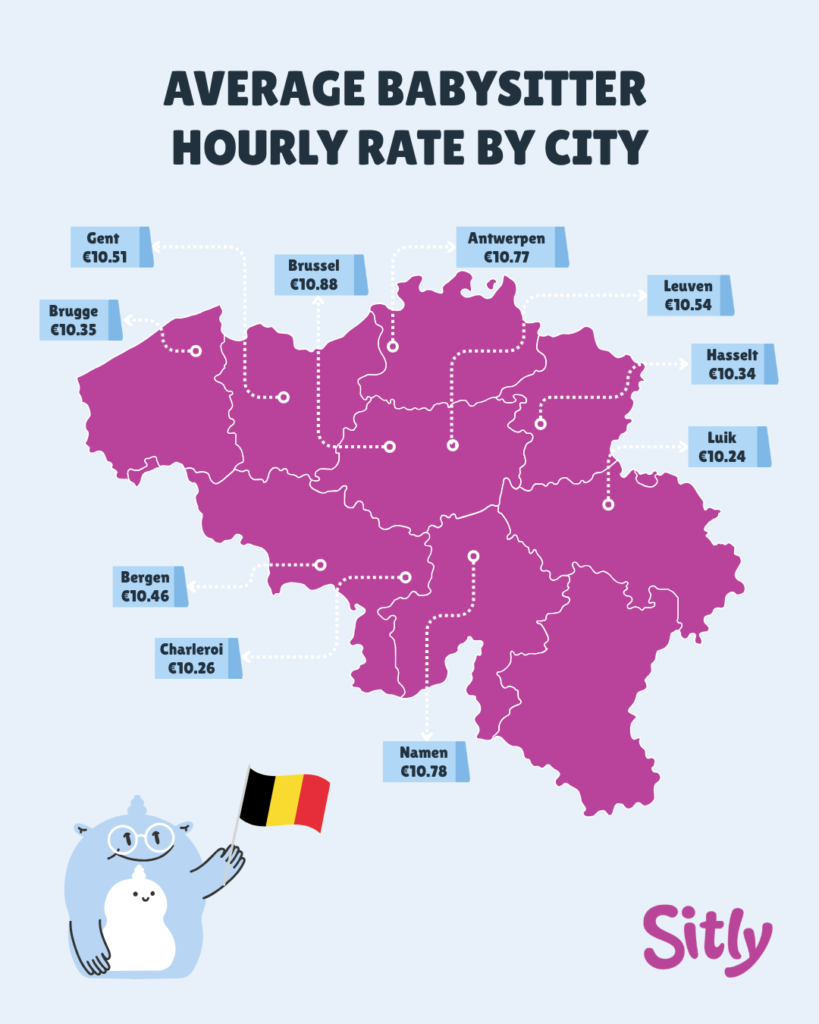
So it’s entirely possible for an experienced babysitter in a small town to earn more than a beginner babysitter in a big city, especially if she’s looking after several young children or taking on more responsibilities. The image below shows the average babysitter hourly rate in Belgium’s major cities, giving you a clearer idea of what you can ask for.
Map showing babysitter hourly rates in major cities
Calculating a Babysitter’s Pay
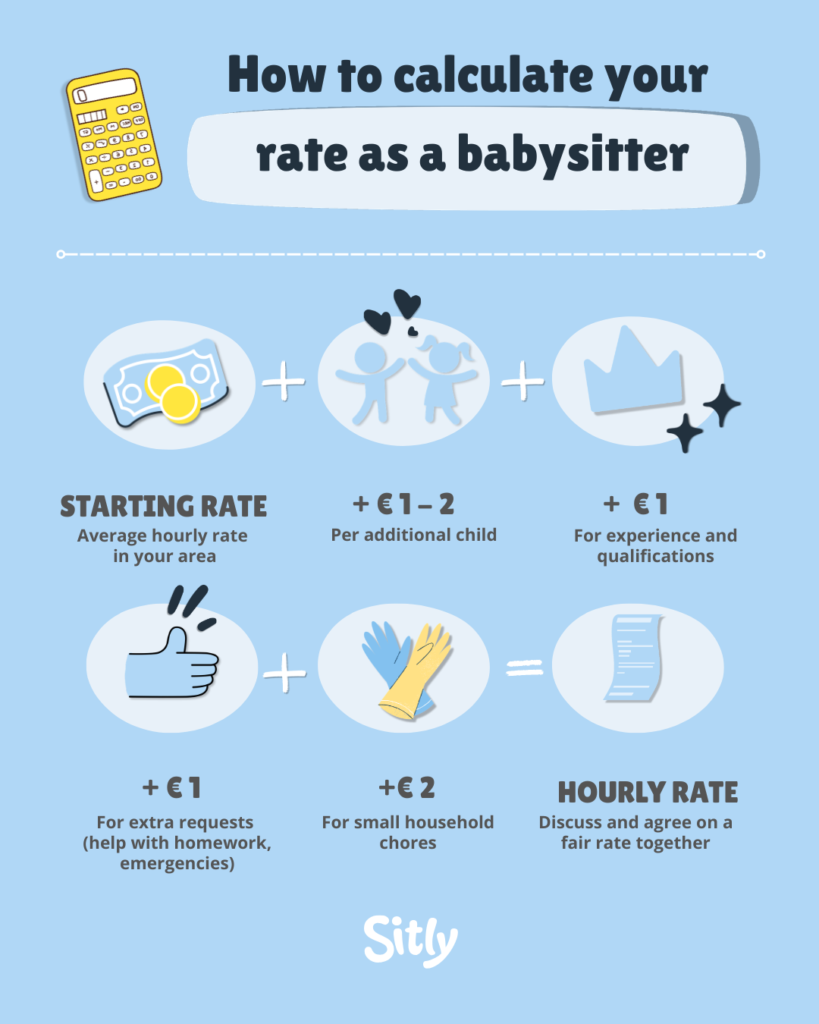
Beyond the city where you work, many factors influence your pay as a babysitter. Consider your experience, qualifications, the number of children you’re looking after, and any extra tasks you take on. All these elements affect your final hourly rate.
The infographic below gives you an overview of the rates and helps you realistically estimate your hourly rate based on the type of care and tasks you carry out for a family.
Infographic: Calculating a babysitter’s pay
How Much Does an Experienced, Qualified Babysitter Earn?
If you’ve been working with children for years or have completed specific training (such as childcare, education, or a recognized first aid course), you can ask for a higher rate. Families are often willing to pay more when they see that you’re professional, reliable, and have caregiving or educational skills.
How Much Does a Babysitter Earn Per Hour for Two Children?
When you look after two or more children, it’s common for your hourly rate to be slightly higher than your base rate — usually 10 to 20% more, depending on the extra responsibilities involved. Looking after two young children at once takes more attention, organization, and energy than caring for a single older child. When the children are different ages, the job can also be more demanding, since you need to adapt activities, meals, and routines to each child’s needs. So it’s entirely normal for this extra workload to be reflected in your pay.
Babysitter Hourly Rate with Light Household Tasks
Putting away toys you played with together, loading glasses into the dishwasher, or preparing a snack are usually part of a babysitter’s standard tasks.
But if a family asks you to also cook, do laundry, vacuum, or handle other household chores, these should be paid separately. In that case, you can ask for an additional amount on top of your hourly rate.
Babysitter Rate When Using Your Car
Many babysitters pick children up from school, take them to sports or music lessons, and then bring them back home. If you use your car for this, you can agree with the family on a weekly or monthly allowance to cover fuel costs.
What’s a Babysitter’s Rate in the Evening or Overnight?
What you earn as a babysitter in the evening depends on the type of tasks involved. When the children are already in bed and generally sleep well, the hourly rate is often a bit lower. But if you know that young children wake up regularly and you need to stay alert the whole time, it’s entirely reasonable to ask for a higher rate.
If you work after 10 PM, or if the parents come home so late that it’s better to stay overnight, it’s entirely possible to agree on specific pay for these situations. Overnight care involves extra responsibility and often justifies additional compensation. After all, babysitting is real work that deserves pay suited to the responsibilities taken on.
Some babysitters choose to charge the same rate in the evening as during the day. Even when the children are asleep, they remain responsible for their safety and need to be able to step in if necessary. Others feel a slightly lower rate is acceptable when the job is especially quiet — for example, if they can watch a movie, study, or do homework while the children sleep. There’s no strict rule: what matters is that the agreed rate reflects the responsibilities taken on and suits both parties.
Tip: agree in advance on how you’ll get home safely after the job. Can the parents drive you back, arrange a taxi, or walk you to your car? Your safety matters, and it’s best to discuss this ahead of time so everyone knows what to expect.
Example Babysitter (16 years old) – 2 Children, Weekend Evenings
Lia is 16 and in her fourth year of high school. She already has two years of babysitting experience, mainly with her younger brother and cousins. In the family she’s currently sitting for, she looks after two children over the weekend. She arrives at 7:30 PM, when the children are already asleep, and stays until 11:30 PM. The parents then drive her home. During the evening, she can help herself to a drink, and the parents only ask her to empty the dishwasher.
What’s a reasonable rate for Lia?
- € 8.00→ Suggested rate for teen sitters with light duties
- +€ 1.00/hour → For supervising an additional child
= € 9.00/hour
She works 4 hours: €9.00 × 4 = Total pay €36.00.
Babysitter Pay: Hourly or a Fixed Monthly Amount?
What’s better: being paid hourly or agreeing on a fixed monthly amount? It mainly depends on how often you babysit and how regular your hours are.
If you babysit occasionally or your hours vary regularly, an hourly rate is usually the simplest solution. You’re then paid based on the actual number of hours worked.
On the other hand, if you work regularly for the same family, it might be more convenient to agree on a fixed monthly amount. In that case, it’s important to clearly define what this arrangement covers, for example:
- Are you paid on days when they don’t need you?
- Is overtime paid if you’re asked at the last minute to stay longer?
- What if you always work on Tuesdays, but there are five Tuesdays this month?
Tip: discuss these kinds of questions in advance to avoid misunderstandings and maintain a good working relationship with the family.
Last-Minute Babysitter Rate in Case of Emergency
What should you do if a family calls you last minute due to an emergency, for example early in the morning because the child is sick? In this case, you can usually ask for 10 to 20% more than your usual rate.
It’s a good idea to agree in advance on an “emergency rate” for situations where you need to step in unexpectedly. That way, everything is clear, and your flexibility is fairly compensated.
Example: Babysitter (17 years old) – 2 Children, Wednesday Afternoon
Emma is 17 and in her sixth year of high school. She babysits regularly through Sitly and has completed a Child First Aid course. On Wednesday afternoon, she’s called last minute by a family who needs care for two children aged 5 and 8. She arrives at 1:00 PM, picks the children up from after-school care, gives them a snack, plays with them in the garden, and looks after them until the parents get home around 5:30 PM.
What’s a reasonable rate for Emma?
- € 8.00/hour → Indicative rate for student
- +€ 1.00/hour → Additional child
- +€ 0.50/hour → Last minute call
= € 9.50/hour
Emma works 4 hours, so: €9.50 × 4 = €38.00.
How Much Does a Babysitter Earn Per Month?
A babysitter’s monthly income depends heavily on the number of hours worked and your experience. A part-time babysitter working around 20 hours a week earns an average of between €850 and €1,000 a month.
If you work full-time and have qualifications or experience with babies or children with special needs, your income can exceed €1,600 a month. Some nannies with more responsibilities or living with the family can earn even more. In that case, it’s a formal job with an employment contract and social security contributions.
How Much Does a Babysitter Earn Per Day?
If you only work certain days, for example during school holidays or when parents are away for work, you can agree on a daily rate instead of an hourly rate.
The calculation is simple: multiply your hourly rate by the number of hours worked.
An 8-hour day earns on average between €90 and €120, but the amount can be higher if you’re looking after young children, preparing meals, or also staying in the evening.
Tip: agree clearly with the family on your working hours, exactly what you need to do, and how overtime is paid if you need to stay longer unexpectedly.
What Rate Should You Ask for as a Babysitter?
To determine your hourly rate, you should take several factors into account:
- your experience and any qualifications
- the number of children and their ages
- the average rate in your area
- the time of day you work (daytime or evening)
- and the responsibilities you take on
Once you’ve chosen the rate that suits you, the next step is to discuss it with the family. This might feel a bit awkward at first, but clear agreements from the start are the best way to avoid misunderstandings and keep the job enjoyable.
A good approach is to come prepared: find out the going rates in your area, and calmly explain during the conversation why you’re proposing a certain rate — for example, because the children are young, the hours are late, or extra tasks are involved.
You can also start by asking what budget the family has in mind. This makes the conversation more open and makes it easier to reach an agreement together that’s fair and realistic for everyone.
Table of contents



In 2026, the average hourly rate for a babysitter in Belgium is around €10.04 per child. This national average is based on the rates of thousands of babysitters active on the platform. These are mainly occasional bookings, carried out by teenagers or students who babysit in their free time, often in the evenings or on weekends. This figure remains an indication: some charge lower rates, while experienced or city-based babysitters may ask for a bit more.
Several factors influence the hourly rate. Age and experience play an important role: older or more experienced babysitters generally charge higher rates. The number of children and their ages also matter, since looking after a baby or several children at once requires more responsibility. Extra tasks like cooking, helping with homework, or doing light household chores further increase the rate. Region is also a key factor: rates in cities are generally higher than in smaller towns.
Yes, there’s a clear difference between cities and rural areas. In urban regions with a higher cost of living, such as Brussels or Antwerp, rates are noticeably higher. For example, a babysitter in Brussels earns on average around €10.71 per hour, while in smaller towns, rates are often below €9 per hour. This difference is partly explained by higher demand for babysitters in cities and higher spending capacity among families there.


Flexible babysitting jobs, just around the corner
Love spending time with kids? Become a Sitly Sitter! We connect you with families looking for a reliable sitter. Set your own schedule, choose your rates, and meet families nearby. Get started today!

Related Articles

Calculate Your Babysitter’s Rate with the Sitly Calculator
Find out how much to pay a babysitter in your area. Sitly’s Babysitter Rate Calculator shows average rates across Belgium and helps you estimate a fair hourly wage based on your city, number of children, and any extra duties.

15 Easy Part-Time Jobs as a Student — from Babysitting to Tutoring and Private Lessons
Seeking to earn some extra money as a student or in addition to your current job? Finding the right part-time work can provide you with the flexibility to earn an income while still focusing on school and your personal life. In this guide, we’ve rounded up19 of the best and most flexible side jobs. Many of them can be done from home, like filling out online surveys, babysitting, or tutoring, while others let you get outside, be creative, or meet new people.

How to Become a Great Babysitter
If you want to become a babysitter and find regular work, the key is to build experience, gain parents’ trust, and show that you take the role seriously. Even if you’re young, you can start by helping family members, offering to work as a “mother’s helper,” taking a First Aid and CPR course, and creating a professional babysitter profile on a platform like Sitly. By setting a fair hourly rate based on your age, experience, and responsibilities, and by going the extra mile during each job, you’ll increase your chances of getting more babysitting work and keeping parents happy.